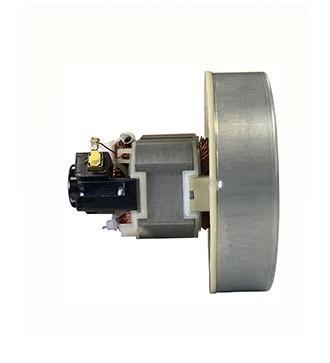
A part number is an internal reference, not a technical specification. When a vacuum cleaner motor has to be reordered and the code on the drawing or the label no longer matches what the supplier quotes back, the exchange is only safe if both sides are describing the same electromechanical duty. Below is the sequence our engineering team follows when a buyer brings us a superseded number, and what we ask them to confirm before any sample or production order is opened.
The first thing we pin down is the operating envelope the motor actually sees in the finished machine. For the high-speed brushless units listed under our motor and accessory range for cordless vacuums and floor washers, that envelope is defined by four figures: rated DC voltage, input power, rated speed and the control scheme the driver uses. A replacement can share a shaft diameter and still fail in the field if the voltage band or the drive method is wrong.
| Parameter | What we confirm on both drawings |
|---|---|
| Rated DC voltage | Battery pack nominal and cut-off voltage, not just the label value |
| Input power | Continuous input at the duty the machine runs, plus peak during start-up |
| Rated speed | Target rpm band under load, and how it is measured on the test bench |
| Control scheme | Square-wave drive or field-oriented control (FOC), and the protection functions the driver provides |
| Expected lifetime | Hours of operation the warranty and service-life target assume |
Our published product pages state these ranges for the category, and they are a useful starting point rather than a substitute for your own drawing: 12-18 V rated DC voltage, 100-180 W input power, 30,000-60,000 rpm rated speed, square-wave control, and a 200-400 h lifetime band. If your current motor sits outside those ranges, treat the reorder as a new development item and plan for samples and bench testing before a bulk order.
Buyers often compare two motors by rpm alone. Speed is the entry condition, not the result. At ultra-high rotational speed the rotor deals with centrifugal load, eddy-current losses, bearing temperature and vibration at the same time, and each of those constrains the others. A higher-rpm substitute that was never balanced or thermally sized for your housing can pass a bench run and then fail on noise or on magnet life in the field.
So when a part number changes, we ask what sits behind the speed claim on both sides of the exchange:
A superseded number frequently hides small interface changes that only surface on the assembly line. We ask buyers to send the mounting drawing rather than a photo, and we compare dimension by dimension: shaft diameter and length, flange and mounting-hole pattern, bearing type and enclosure, terminal position and wire gauge, connector housing if one is used, and the fan or impeller interface where the motor drives the air path directly. Fastener torque figures and any balance marks belong in this comparison as well.
For buyers assembling kits at destination, this is also the point where supply format matters. The same component can be shipped as part of a finished unit or inside an SKD or CKD kit, and the packing, protection and documentation differ accordingly.
Certification scope is per model, not per company. Before reordering under a new number, ask which report covers this exact motor, what the model designation on the certificate is, and whether the version you receive matches it in materials and construction. A component that passed assessment under one configuration can fall outside the file after a winding, magnet or enclosure change. Only model-specific documents support claims about an individual item; company-level certificates do not transfer to a substitute.
Ask also for the incoming inspection items the supplier runs - raw material checks, semi-finished and finished product testing, performance checks and high- and low-temperature testing are part of how we document each exported batch. Buyers who want to verify in person are welcome at our factory and warehouse in Zhongshan to inspect and test goods before purchase.
We treat a part-number substitution as complete only after a sample round with agreed pass criteria. In practice that means bench records of voltage, current, input power and speed at the same operating points; a temperature-rise run at the duty cycle your machine actually uses; noise and vibration comparison against the retained reference unit; a load sweep across carpet and hard-floor conditions if the driver supports dynamic power adjustment; and a blocked-intake stall test to confirm the protection cuts in.
Release checklist we ask buyers to sign off
Reordering under a different number is usually harder when the motor, driver and air path come from separate vendors, because nobody owns the interface. We work as a home appliance export supplier covering component procurement, processing, semi-product assembly and inspection in one chain, alongside blender, oven, range hood and refrigeration parts, which lets us hold the whole interface conversation with one engineering desk. We keep long-term stock of appliance electrical components - BLDC motors, series motors, control panels, PCBAs, capacitors and starters among them - for importers, manufacturers and after-sales operators, and we accept small trial orders so a substitution can be validated on a real line before it is committed to volume.
Send us both drawings
If you are reordering a vacuum cleaner motor under a changed part number, send the old and new specification sheets plus the mounting drawing. We will return a parameter-by-parameter comparison, tell you where the substitute deviates, and propose samples for your bench before any bulk order is opened.